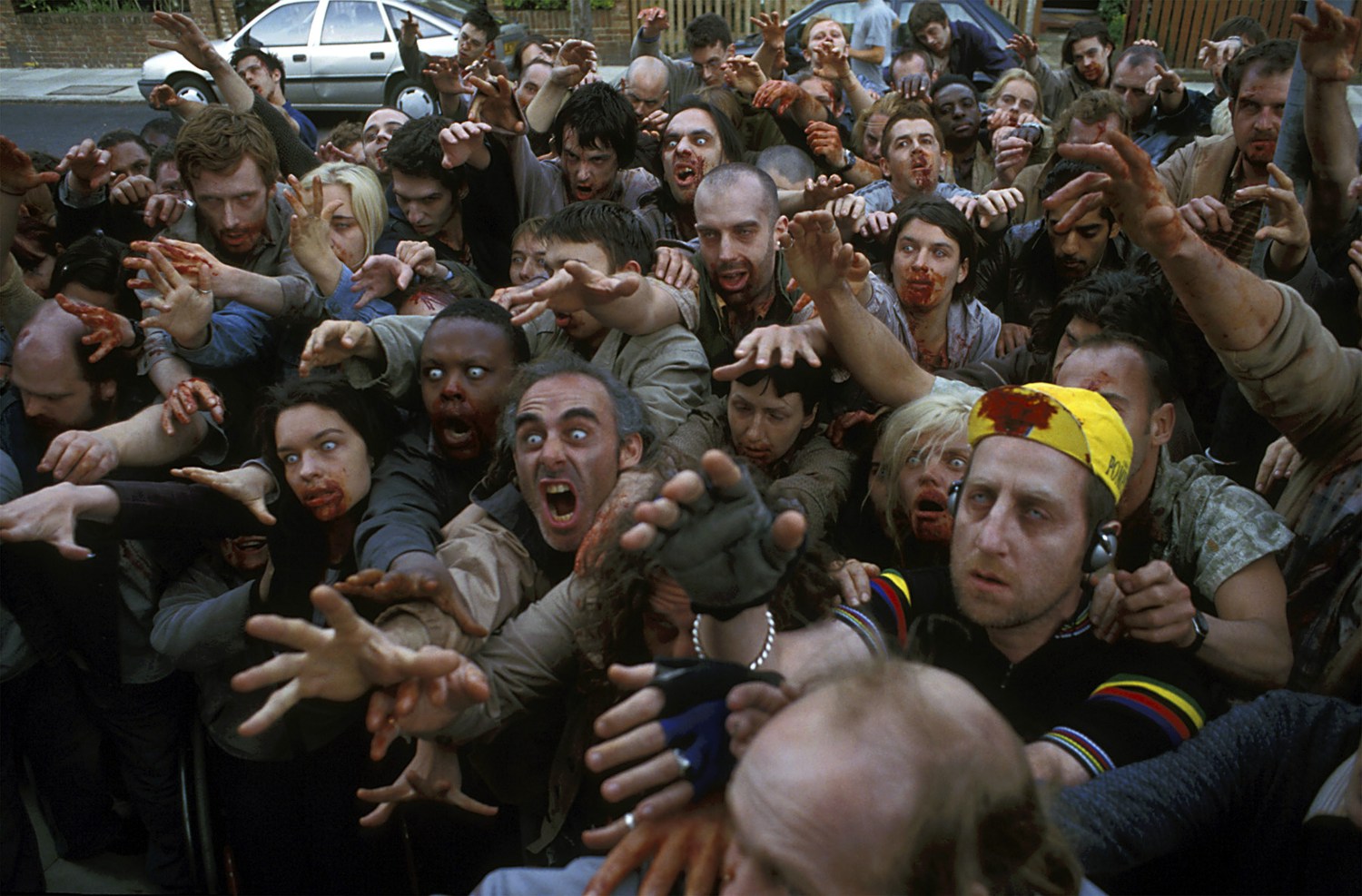
The easy is answer is pretty straightforward — because they’re walking corpses who feast on human flesh. But there’s more to it than that. Movie monsters come and go. Some are corny, some are genuinely frightening, but most are fairly transient in the popular imagination. And yet zombies have been strangely and ironically durable. There’s something about the idea of the undead, something that makes zombies both unnerving and compelling, that has made them an indelible part of American horror cinema.
The Second Breakfast Podcast (from the inestimable Andy Roth and Phil DeVaul) discussed this topic in their most recent podcast. I encourage you all to watch it in its entirety:
[youtube=”http://www.youtube.com/watch?v=Z_IKEfizfX4″]
The Second Breakfast guys raise a number of good points about what makes zombies frightening: First, the undead multiply very quickly. Zombie movies play on our fears about a devastating outbreak and an inability to contain a quickly-spreading contagion. Part of the terror comes from the idea that the outbreak is so sudden, and so foreign, that by the time anyone realizes what’s happening, it’s already too late.
Second, you cannot outlast zombies. They’re a continually lurching horror, one that cannot be simply ignored or waited out. This longevity adds to the looming sense of dread in every zombie film. The survivors in a zombie film are not simply waiting for the storm to pass so things can return to normal. They’re trying to figure out what kind of life they can have in a world where they’re under a constant, mortal threat.
Third, they’re your friends and neighbors. There’s something inherently unsettling about having to kill something that, whatever its level of decay and depravity, still appears human. As Andy Roth describes in the above video, zombie movies often feature characters having to kill one of their close friends or family members who’ve turned. There’s an added level of horror to the idea of having to slay a monster who still looks like someone you love, and it makes the undead unique among cinematic monsters.
But I think there’s something else, something more elemental, that makes zombies not only frightening but also compelling as monsters.
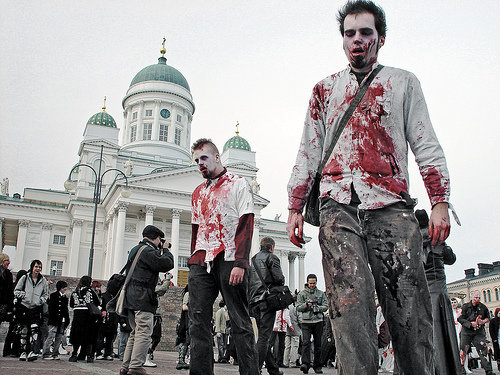
"Damn tourists."
There’s a certain type of fear that zombies exploit, and it manifests itself both internally and externally. The external aspect is one that Phil DeVaul touched on in the podcast — the rise of the undead as a critique of society. As Phil notes, there is something off-puttingly prophetic about the zombie apocalypse, not in the sense that we should genuinely fear an outbreak of the walking dead, but in the sense that these films posit that there’s something both flawed and fragile about our civilization, and that it would not take much to push it past the tipping point.
That fragility is the heart of what makes zombies so scary — the idea that everything we know, everything we feel so secure about, sits on a precipice, and the wrong move could send it all tumbling down. Look at how quickly society crumbles in films like Dawn of the Dead or the aforementioned 28 Days Later or The Walking Dead. Zombie-related media does not have a monopoly on this sense of how tenuous the grip on our way of life is, but it certainly capitalizes on it. Works like World War Z are quick to emphasize the contradiction in how we marvel at the grand achievements of our civilization, and how quickly they could all be washed away. That thought, that such a systemic breakdown could be so close, is both a troubling and captivating one.
But there’s also an internal aspect of that fear from fragility. Namely, that more frightening than the fall of society is the fall of the self. Zombies, with their insatiable hunger and single-minded focus, represent the idea of our base instincts taking over our better natures. They are, in fact, pure instinct, a tribute to and a caution against the mindless beast lurking beneath the surface.
There are two facets of the fear that comes from that internal fragility. The most obvious is the zombies themselves. One bite, one scratch, one bit of contact with tainted blood, and all the dignity, all the reason, is completely stripped away from a person. It’s frightening to think of that abject brutishness taking over, particularly when, in the throws of a zombie outbreak, it could happen so easily. Philosophers like David Hume rejected the notion of man as “the rational animal,” arguing that reason was often a slave to passion and taste. The undead are that notion taken to a frightening extreme. The bitten and infected become brainless animals, ruled entirely by impulse, and they are powerless to stop it.
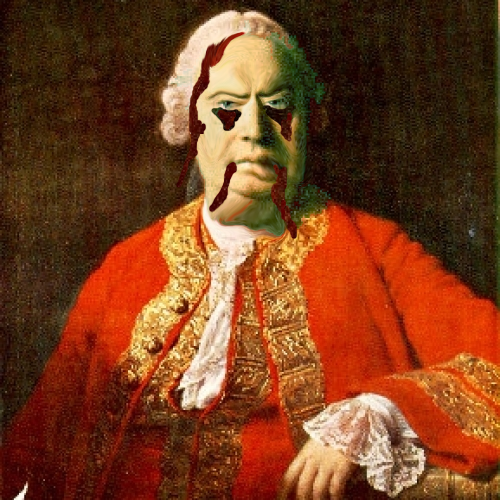
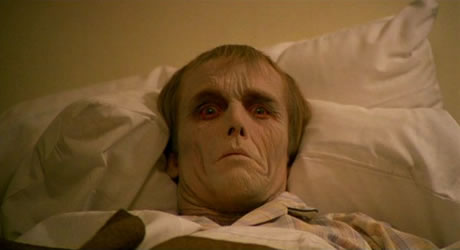
In that spirit I give to you...Zombie David Hume
That powerlessness is another big part of what makes zombies so terrifying. The undead not only represent a complete shattering of our reason, our ability to be more than mere mentally-drifting creatures consumed by our baser urges, but also a futility in our ability to fight against that descent into blind savagery. The fruitless fight against the change is one of the most resonant and repeated points in the zombie canon. In almost every work about the undead, there’s at least one person who gets bitten and struggles in vain to stay among the living, only to inevitably succumb to the infection.
As Andy mentioned in the podcast, one of the most devastating scenes in Dawn of the Dead occurs when one character uses his last dying breath to beg his companion, gun at the ready, for some small mercy. “Don’t do it ’till you’re sure I’m coming back. I’m gonna try… not to. I’m gonna try not to come back. I’m gonna try… not to.” He, of course, does; his companion is reluctant, but deliberate, and shoots the shell of the man that lingers behind. It’s a particularly chilling moment that underscores the point.
Scott Reiniger, one of Second Breakfast's famed "Those Guys."
Different works have used that mindlessness to stand in for various ideas: racism, consumerism, retributivism, etc. But at their core, they’re all underlied by a fairly simple premise — the worst of mankind is not that far away, and by the time circumstances have arisen to bring that to the fore, the battle has already been lost.
In the same vein, the other facet of that internal fear comes from the people who have managed to survive. It’s a subject that’s been explored in post-apocalyptic films of all varieties. How do people behave when there’s no one to enforce the rules and the protective veneer of society’s norms have been stripped away? Many devolve into cruelty, hedonism, selfishness, and worse when the metes and bounds of civilization are removed. The living, in a zombie film, are a mirror image of the undead – a parallel instance of nominally civilized people giving into their weaker selves wholesale.
The scariest part of all of this is not the concern that these terrible circumstances destroy our society or strip away our humanity. It’s the fear that they reveal them. It’s the concern that these base instincts are humanity and that our grace and gentility and our achievements as a species are all fragile constructs, easily shattered in the face of overwhelming fear, want, and desperation.
Zombies are compelling because they’re a view of the worst case scenario, both for the world humanity has built and for humanity itself. That view is troubling, even disquieting, but it also makes it hard to look away. From the shambling id of the undead themselves, to the crumbling societies built on flimsy fables of security, to the surviving men and women who often prove themselves scarcely worth being saved, zombies are scary and yet irresistible because they present a stark, chilling thought:
This is what we are. And all we are. And your day will come.

8 Responses to What Makes Zombies So Frightening?